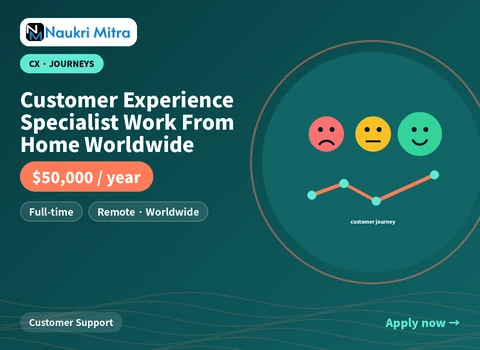
A remote Customer Experience Specialist position paying up to $50,000 a year, full-time, with no location restriction on where the applicant is based.
Core responsibilities
- Analyzing customer feedback and journey data to spot patterns
- Flagging the specific moments in a customer's journey where things break down
- Collaborating with support and product teams to implement improvements that raise satisfaction and retention
The role sits between two groups that don't always communicate directly. Support agents hear complaints one ticket at a time. Product teams build features months before any customer uses them. A specialist's job is to connect those two views, turning a pattern buried across hundreds of individual tickets into something concrete a product manager can act on.
What that looks like in practice
Say churn ticks up two percent in a quarter. A specialist digs into the journey data behind it and finds that customers who contact support during their first week are twice as likely to cancel within sixty days as those who don't. That's not a complaint anyone filed directly; it's a pattern that only shows up once someone connects the support logs to the retention numbers. From there, the specialist works with the onboarding team to test a change, maybe an earlier check-in call, and tracks whether it actually moves the number or just shifts the problem somewhere else.
Education and experience required
A bachelor's degree is the educational requirement, generally in business, communications, or a comparable field, though a closely related discipline that covers similar analytical ground would also count. On the experience side, candidates need 18 months working specifically on customer satisfaction metrics rather than general customer service, since the analytical component here goes beyond handling individual cases.
Skills that matter
Customer journey mapping sits at the center of the role, along with data analysis strong enough to turn a spreadsheet of feedback scores into an actual recommendation. CRM software experience is expected, and process improvement work, actually changing how something operates rather than just documenting that it should change, separates a strong candidate from an average one. Communication matters throughout, since half the job is presenting findings to teams that didn't ask for them and getting buy-in anyway.
Beyond the required set, familiarity with a specific analytics platform such as a customer feedback tool or a BI dashboard tends to shorten the ramp-up period. Some exposure to A/B testing or experiment design is a genuine plus too, since testing whether a proposed fix actually works is often as important as identifying the problem in the first place.
Pay and schedule
This is a full-time, fully remote role paying up to $50,000 USD annually and open to candidates anywhere. Naukri Mitra lists a number of customer experience specialist jobs worldwide under similar terms, and this particular opening carries no requirement to work a specific region's business hours, though some overlap with the core team's working day is generally expected for meetings.
Benefits
- Health coverage
- Paid time off
- Remote-work flexibility
- Life and disability insurance
The disability and life coverage tends to get overlooked alongside salary and PTO, but for a fully remote role with no office-based safety net, it's worth weighing carefully rather than treating it as boilerplate.
How the work gets measured
Performance in this role tracks against a handful of concrete numbers rather than subjective impressions. Satisfaction scores, retention rates in the weeks following a support interaction, and the actual adoption rate of any changes proposed all factor in. A specialist who identifies ten issues but sees none implemented isn't performing as well as one who identifies three and gets all three tested and rolled out, even though the second number sounds smaller on paper. Reporting cadence is usually monthly for broader trend reviews, with shorter check-ins whenever a specific test is running so a change doesn't quietly go sideways for weeks before anyone notices.
Where the analysis gets difficult
Data rarely points cleanly in one direction. A specialist might find that a change improves satisfaction scores while quietly increasing support ticket volume, because customers who now understand a feature better also feel more comfortable asking follow-up questions about it. Deciding whether that trade-off is worth it and explaining that reasoning to a product team that only sees the ticket volume going up is a real part of the job that a resume line about "data analysis" doesn't capture.
Getting a recommendation adopted also takes more than being right. A specialist who hands a product team a finding without a workable next step usually watches that finding sit unused, while one who pairs the same finding with a specific, testable change tends to see it actually implemented.
Getting in without a direct-match resume
Candidates coming from a support role who've spent real time in the underlying data, not just handling tickets but pulling reports and noticing patterns on their own initiative, often make a stronger case than someone with a marketing analytics background but no direct customer contact. That's usually the more realistic route for becoming a remote customer experience specialist without years already logged under that exact title. What tends to matter most in review is evidence of having actually changed something based on data, even something small, rather than a degree title alone.
Growth from here
Specialists who spend a couple of years in this kind of role commonly move into customer experience management, overseeing a small team of specialists rather than running individual analyses themselves. Others move sideways into product roles, since the pattern-recognition work here overlaps heavily with early-stage product research. Neither path comes with this specific opening guaranteed, but both are common enough in the field to be worth knowing about.
How to apply
Applicants should be ready to walk through a specific example of a customer insight they identified and what happened after they acted on it, since that kind of concrete example carries more weight in review than a general skills list. Applications are accepted on a rolling basis, and the position remains open until it's filled.