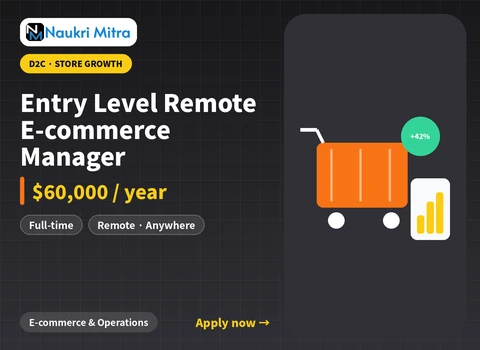
This is an entry-level opening for someone who's already gotten their hands dirty running an online store, even briefly, and wants the next step to be a full-time role rather than another internship. It's full-time, fully remote, open to candidates anywhere, and pays $60,000 a year. The work covers everything from catalog upkeep to campaign planning to reading the numbers that show whether any of it is actually working.
What you'd actually be doing
- Keep the online store running day to day, from live product pages to checkout flow
- Build and update the product catalog, and plan promotions around it
- Dig into sales and traffic numbers to figure out what's converting and what's leaking customers before checkout
A typical week might start by pulling last week's conversion numbers to see whether a homepage change actually helped, then move to updating product listings ahead of a seasonal promotion, and end with a quick fix to a shipping calculator that's been quoting the wrong rate for one region. The job constantly moves between analysis and hands-on store management, and the balance between the two shifts depending on what's happening that week.
What you need to walk in with
A bachelor's degree is required, typically in business, marketing, or a related field. This entry-level role is looking for 10 months of experience managing an online storefront or driving e-commerce growth; this intentionally light requirement is meant to be an early step rather than a role for someone with years already behind them. A part-time job, an internship, or a self-run online shop all count toward that experience as long as the work was real.
Skills that matter here
- Comfort working inside platforms like Shopify or Magento
- Digital marketing fundamentals, enough to run or support a promotional campaign
- Inventory management, keeping stock levels and product data accurate across the catalog
- Analytics skills sharp enough to turn raw traffic and sales data into an actual decision
- Project management, since campaigns and catalog updates rarely run on their own timeline
A working sense of which metrics actually matter for a given decision, versus which ones just look interesting on a dashboard, matters just as much as raw analytics skill. It's the kind of judgment that develops fast once you're actually accountable for a store's numbers.
Hands-on experience with Google Analytics gives an application a real edge, and so does any background running email marketing campaigns or basic SEO work. A/B testing experience is a plus too, though it's rare to see in someone this early in their career, so don't count yourself out if you haven't run a formal test yet. What matters more at this stage is whether you can talk clearly about a decision you made based on data, even a small one.
Compensation
- Health insurance
- Paid time off
- 401(k) matching
- Performance bonuses tied to store growth metrics
Naukri Mitra notes that some employers in this space also add stock options or profit-sharing to the standard package, and this particular role includes these as part of total compensation rather than just the base benefits. Details on vesting or eligibility for that piece typically come up during the offer stage.
What makes the job genuinely demanding
E-commerce doesn't pause for a bad day. If a promotion launches with a broken discount code, customers notice immediately, and the fix can't wait until tomorrow. Revenue numbers are visible in near real time too, so a slow week shows up on a dashboard before anyone has to explain it in a meeting. That visibility cuts both ways: a strong campaign is just as obvious as a weak one. Getting comfortable with that level of exposure early on tends to make the rest of a career in this field feel less intimidating, since the numbers stop feeling personal after the first few rough weeks.
There's a real payoff in that immediacy, though. Watching a promotion you built actually move the numbers in a way you can point to directly is a kind of feedback loop that a lot of entry-level jobs simply don't offer. Most people who stick with this field describe that direct line between their work and a measurable result as the reason they got hooked on it in the first place.
Who tends to land this role?
People coming out of a marketing or business program who have run a small online shop, managed a campus organization's merch store, or completed an e-commerce-focused internship tend to be strong fits. Someone who spent a summer running a family business's online storefront, even informally, often has more relevant experience than their resume title suggests. Reviewers tend to weigh that kind of scrappy, hands-on background more heavily than a purely academic project.
Remote e-commerce manager jobs for no-experience candidates who worry they can't land are actually a fair target here, since 10 months is a modest bar by industry standards. What matters more than tenure is whether you can point to a specific number you moved, a conversion rate you improved, or a campaign that outperformed expectations. That specificity does more for an application than a long list of platforms you've heard of.
Pay and next steps in the field
E-commerce manager remote salary figures at this experience level generally sit close to what this role offers, and people asking how to become a remote e-commerce manager typically find that a documented result, even a modest one from a small store, matters more than the specific platform experience listed on a resume. A concrete before-and-after number tends to carry more weight in an interview than a bullet point listing tools.
Applying
Send a resume along with a short note on any store or campaign you've managed directly, even informally. If you can point to a specific number you moved, mention it. Applications are reviewed on a rolling basis, and candidates who move forward typically hear back within one to two weeks. A short case-study-style exercise that walks through how you'd approach an underperforming product page is common for finalists.