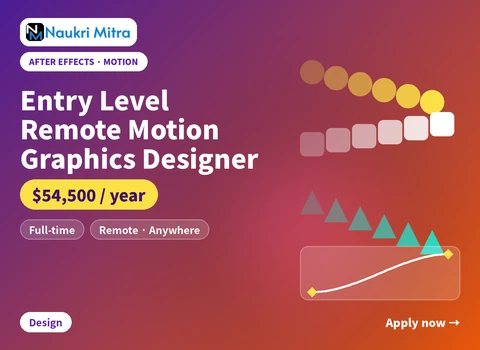
Full-time, fully remote, entry-level motion graphics opening, open to candidates anywhere, paying up to $54,500 a year. The bar to get in the door is lower than most design roles: 8 months of relevant experience is enough, which makes this a realistic first real job for someone who's spent the last year or two building a reel on their own time.
What the work looks like
The core of the job is turning static ideas into things that move. That covers a lot of ground: short animated pieces for a marketing campaign, effects work dropped into film or product footage, and the earlier step of sketching a storyboard before any actual animation starts. Feedback on this kind of work tends to be creative rather than technical, things like pacing, timing, or whether a transition feels right rather than a bug to fix, and revising based on that feedback happens constantly.
- Turn scripts or concepts into finished motion pieces and effects work across ad, film, and product-related projects.
- Sketch out storyboards before moving into full animation, so the concept is settled before the time-consuming work starts.
- Take creative notes and revise cuts or animations as needed, sometimes over several rounds.
- Keep project files organized enough that someone else could pick up a piece mid-process if needed.
A fifteen-second product teaser that needs kinetic type synced tightly to a music beat is a fairly typical assignment here. Getting the timing right usually takes a few passes, nudging text a few frames earlier or later until it actually lands with the rhythm instead of just sitting near it. That kind of fine-tuning, repeated across dozens of small projects, is most of what fills a week in this role.
Storyboarding comes earlier in the process and is skipped by newer designers more often than it should be. A rushed storyboard usually shows up later as wasted animation time, when a sequence has to be reworked because the pacing or shot order never quite made sense on paper. Slowing down at that stage tends to save time overall, even though it can feel like the slower path in the moment.
What gets you considered
This is pitched as an entry-level opening, and the education requirement reflects that. A four-year degree tied to animation or the broader motion design field covers it. In practice, the reel matters more than the diploma title. A short collection of finished or near-finished work that shows range across a couple of different styles tends to say more about someone's ability than a transcript does.
Experience-wise, the listing asks for 8 months in a similar role, which could easily include freelance work, internships, or personal projects if they're documented well. After Effects is the tool this role runs on day-to-day.
- After Effects
- Cinema 4D
- Animation principles
- Video editing
- Storyboarding
- Comfort moving across different creative software
Extras that help
None of the following are required, but they'll strengthen an application. Some illustration or 2D character animation experience, since it broadens what kind of projects someone can be handed. Basic sound design or audio-syncing skills, given how much motion work lives or dies on whether the visuals actually match the beat or the voiceover. Familiarity with Premiere Pro rounds things out well for anyone doing effects work inside a longer video edit rather than a standalone piece. A habit of studying reference footage or other people's reels before starting a new project also tends to lead to stronger, more considered work later.
Pay and what's included
The salary here is up to $54,500 a year for full-time, fully remote work. Health coverage, paid time off, and remote-work flexibility are all part of the package. Naukri Mitra also notes that many employers in this space conduct regular performance reviews tied to merit-based raises, so income here isn't fixed at the starting amount for however long someone stays.
Motion graphics designer remote salary figures for entry-level roles land in a fairly tight band industry-wide, and this one sits right in the middle of it rather than at either extreme.
What it's actually like day to day
Small projects move fast here, sometimes from brief to finished file in a day or two, which suits someone who likes seeing quick results over someone who prefers sinking weeks into a single piece. There's also a fair amount of built-in repetition: template-style pieces get reused and reskinned for different clients or campaigns, and getting comfortable with that kind of variation-on-a-theme work is part of settling into the role.
Because the work is remote and the team is small, most check-ins happen over shared review links rather than live meetings. A supervisor might drop timestamped comments directly on a video draft rather than scheduling a call to walk through notes verbally, so getting used to reading and responding to written creative feedback matters just as much as the animation work itself.
People asking how to become a remote motion graphics designer usually assume the technical software skills are the hard part. In practice, most people pick up After Effects reasonably fast. What takes longer to build is a working sense of timing, knowing instinctively how many frames a beat needs to land right, and that only really develops by animating a lot of small things and watching what does and doesn't feel good.
Applying
A reel is required, ideally under two minutes, showing a mix of finished pieces rather than one long, unedited project. Applications are reviewed on a rolling basis, and candidates who move forward should expect a short creative exercise, usually a quick animation based on a simple brief, before any formal interview is scheduled. There's no fixed closing date for this posting, so applying as soon as the reel is ready is the better move.