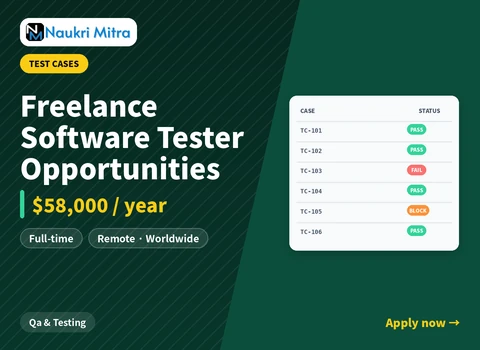
Here's a fully remote software tester role, open to applicants anywhere in the world, paying $58,000 a year for full-time work. The team behind it posts these roles fairly often, and this one's built around steady, ongoing testing work rather than a single short-term project. Among remote software tester jobs currently open, worldwide eligibility like this isn't the norm; many listings that say "remote" still quietly mean a specific country or region.
Someone in this seat spends most of their time in real applications, poking at them from a user's point of view and a more technical one at the same time. It's a job for people who genuinely notice when something's off, even when it's a small thing like a button that's a pixel out of place or a form that accepts input it shouldn't. That instinct matters more here than any single tool on a resume.
Skills You'll Bring
- Comfort with both manual and automated testing approaches
- Hands-on experience with a bug tracking tool, logging issues clearly enough that a developer can reproduce them without follow-up questions
- The ability to design test cases from scratch, not just run ones someone else already wrote
- Genuine attention to detail, the kind that catches the thing everyone else scrolled past
The education bar here sits at a two-year degree, ideally one with a computer science or IT slant, though the field doesn't have to be an exact match. Candidates should also have at least 12 months of hands-on experience testing software, ideally across multiple application types rather than just one product. Someone straight out of a bootcamp with zero applied testing experience probably isn't the right fit yet, but someone who's spent a year testing anything from a mobile app to an internal admin tool has the right kind of background, even without a long formal résumé.
Day-to-Day
The work itself breaks down into a few connected pieces, and none of them occur in isolation. A tester in this role runs planned tests against whatever's currently in progress, writes up what's broken in a way another person can actually act on, then checks back once developers say it's fixed to confirm it holds. Last month, for instance, a reported issue in which a checkout form silently dropped a discount code turned out to occur only in one specific browser version. That kind of detail is exactly what separates a useful bug report from a vague one, and it's usually the difference between a fix landing on the first try or the third.
Some days lean heavily toward writing new test cases for a feature that just landed. Other days are almost entirely spent verifying a batch of fixes before a release goes out. The balance shifts week to week depending on what the development team is working on. There's also a fair amount of back-and-forth built in. A tester who flags a bug well usually gets pulled into a quick conversation about it, not left waiting days for a reply, since the developers on this team tend to work on fixes as close to when they're reported as possible rather than batching them for later.
Nice to Have
None of these are dealbreakers, but they'll strengthen an application.
- Basic scripting ability in Python or JavaScript, useful for writing simple automated checks
- Experience with a test management tool such as TestRail
- Some exposure to mobile app testing, not just web
- Familiarity with Agile or Scrum workflows
Deadlines cluster around releases, and testers usually feel that crunch a day or two before a build ships, when a wave of last-minute fixes all need re-checking at once. Outside of that window, the pace settles down, and there's real room to plan your own day. Naukri Mitra tends to describe roles like this one honestly rather than smoothing over the busier stretches, since a tester who knows what release week actually feels like tends to stick around longer than one who finds out the hard way. The rest of the month runs at a normal, sustainable clip, with enough breathing room to dig into a tricky bug properly instead of rushing a fix just to close the ticket.
This role sits a step apart from a general QA engineer position. It leans more toward hands-on testing across a variety of applications rather than owning the automation strategy for one product end-to-end. It suits someone who likes variety in what they're testing from week to week, rather than someone who wants to go deep on a single codebase.
Pay and Perks
The role pays $58,000 a year. Beyond the paycheck, the package includes a handful of things worth knowing about.
- Health coverage
- Paid time off
- Remote-work flexibility, with the position open worldwide
- Pay that moves up as your work gets stronger, not just as the calendar turns over
That last point matters more than it might seem at first glance. Raises here aren't purely tied to tenure. Someone who's clearly improving, catching harder bugs, writing tighter test cases, moving faster without cutting corners, has a real path to earning more without waiting years for it. Reviews happen on a regular schedule rather than only when someone asks, which takes some of the guesswork out of knowing where you stand.
Getting Started
A resume gets things moving, but it helps to also send along a sample bug report or a test case you're proud of, something that shows how you actually think through a problem rather than just what tools you've used. There's no fixed deadline. The role stays open until it's filled, and applications are reviewed as they come in rather than in batches. The team is spread across enough time zones already that async communication is just how the day runs, so remote here genuinely means remote, not a nearby-city preference in disguise. Anyone unsure whether their background fits closely enough is still worth hearing from; the required experience is a floor, not a strict cutoff, and a strong sample often carries more weight than an exact match on paper.