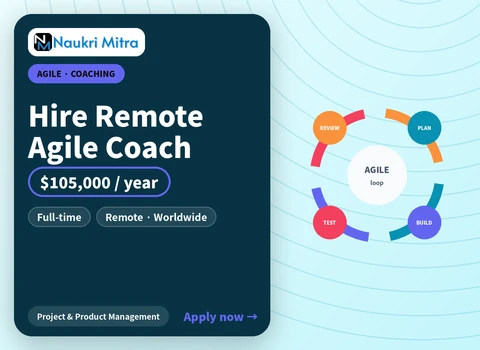
We're hiring a full-time Agile Coach, fully remote, open to candidates anywhere. The role pays up to $105,000 a year and sits in project and product management. This is a coaching role first, not a Scrum Master role with a bigger title attached.
The job, plainly
- Mentor teams and leaders on agile practices, not just teach the terminology
- Facilitate organizational transformation efforts across more than one team at a time
- Remove process obstacles that quietly hurt team performance before they turn into a bigger fight
None of this works from a distance. You'll need to be at the actual ceremonies, not just reviewing reports about them, to catch what only shows up in the room.
Here's a real version of that last bullet: a team runs every ceremony on schedule, checks every box in the agile handbook, and still ships late every single sprint. Nobody in that room is going to say the process is the problem because, on paper, it looks fine. Your job is to notice that, anyway, and figure out what's actually broken beneath the ceremony. Sometimes it's a hidden approval step nobody put on the board. Sometimes it's a manager quietly overriding sprint commitments after planning ends.
What you bring
You need real coaching experience, not a certificate earned last month with no mileage behind it. Leadership and facilitation skills come up daily here, since half the job is getting a room of skeptical directors to actually try something different. The other half is holding a team's trust while their leadership figures that out.
- Deep working knowledge of Agile and Scrum frameworks
- Coaching and facilitation skills that hold up in a tense room, not just a friendly one
- Change management experience, since transformation work always meets resistance somewhere
- A servant leadership approach, meaning your job is clearing the path, not running the show
- A CSP or similar advanced coaching certification
Nice to have
Experience coaching more than one org through a transformation simultaneously is valuable, since the pacing and politics rarely align between them. A background presenting to executive leadership also helps, particularly if you've had to defend an unpopular recommendation and hold your ground. Time spent in a specific industry doesn't matter much here; coaching skills transfer better than domain knowledge.
Education and experience
A bachelor's degree covers the education requirement. In terms of experience, this role calls for 48 months of coaching teams through agile transformations, which is a different track record than simply having run Scrum ceremonies for a few years as a Scrum Master. The distinction shows up quickly in interviews; candidates who've only run ceremonies tend to describe processes, while candidates who've actually coached tend to describe people.
Advanced coaching certifications matter more here than they do in adjacent agile roles. A CSP or comparable credential signals you've gone past the entry-level frameworks into the harder work of coaching coaches and leaders, not just individual contributors. It's not a substitute for the four years of hands-on transformation experience, though; the two need to show up together.
Pay and benefits
This position pays up to $105,000 annually, which is a strong point on the agile coach remote salary spectrum for someone with 4 years of experience specifically in transformation work.
- Health insurance
- Paid time off
- 401(k) matching
- Certification support
- Tuition reimbursement and a learning stipend for continued growth
The learning stipend is worth calling out specifically. Coaching certifications and conferences aren't cheap, and covering that cost signals the employer expects you to keep developing past whatever credential got you hired. Certification support and the stipend are handled separately, so renewing an existing credential doesn't eat into your budget for a new one.
How this role actually plays out
Naukri Mitra fills agile coach jobs worldwide, and this particular opening sits with a company mid-transformation rather than one that's already fully agile. That distinction matters. You won't be polishing a system that already works; you'll be walking into rooms where half the leaders think agile is a fad and the other half think it's already solved, and neither group is entirely right.
Some weeks look like coaching two teams through their first real retrospective. Other weeks look like sitting across from a VP who wants to cancel stand-ups because "they're not adding value," and helping that person actually see what's underneath the complaint. Both are jobs, and the second usually takes longer to resolve than the first.
Building toward this kind of role generally means logging real hours coaching leadership, not just teams, since that's the piece most Scrum Masters haven't done yet when they try to move up. The certification opens the door, but leadership coaching experience is what actually gets you through it. That step usually happens gradually, through a Scrum Master role that begins to touch on program-level conversations before it becomes a formal coaching title.
Applying
Describe a transformation you've coached from a specific starting point to a specific outcome. We want the size of the organization, what resistance looked like, and what changed by the time you left or by the time the engagement wrapped up. Generic descriptions of "driving agile adoption" won't tell us much, and neither will a resume that lists certifications without any story attached.
If you've done this work in a fully remote or work-from-home agile coach jobs capacity before, mention it directly, along with how you handled coaching relationships without being physically in the room. First conversations focus on your coaching philosophy and a transformation you're proud of. If that goes well, expect a second conversation focused on a specific resistance scenario similar to what this team is dealing with now. This posting is actively hiring, and a complete application with concrete examples tends to move faster than a partial one.