Position Summary
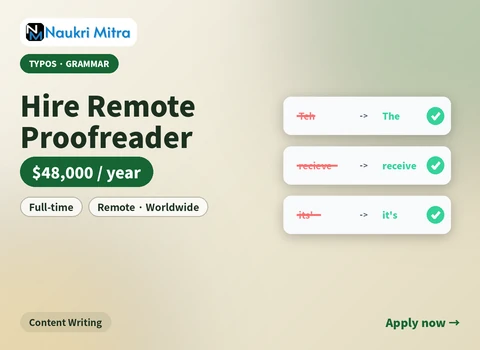
This is one of the more straightforward remote proofreader jobs on the market right now: full-time, $48,000 a year, open to candidates anywhere. The work is the final checkpoint before content goes out the door, catching the misspelled name, the doubled word, the price that reads $84 instead of $48 because a digit got transposed somewhere upstream.
Content volume varies by client, so the mix of material changes week to week. One batch might be a set of product descriptions for an online store, the next a longer report headed for print, and the one after that a batch of email newsletters with a tight publishing schedule. What stays constant is the standard: nothing goes out with an error a careful reader would catch.
Responsibilities
Every piece of content that reaches this desk gets the same level of scrutiny, regardless of length or format.
- Review written content for grammar, spelling, and formatting errors before it publishes
- Check consistency against the relevant style guide for each project
- Serve as the final quality check before content goes live or to print
- Flag inconsistencies in tone, terminology, or formatting that earlier editors may have missed
- Track recurring error patterns and pass that feedback back to writers and editors
Turnaround windows vary by project, sometimes same-day for a short piece, sometimes a few days for a longer document with multiple review rounds. Whatever the deadline, the review itself doesn't get rushed, since a proofreader working too fast is the one place quality tends to slip. A missed typo in a product listing is a minor fix; a missed error in a legal or medical document is a different kind of problem entirely, and this role handles both types of content depending on the client.
Requirements
The role's floor for education sits at a bachelor's degree. English majors are common in this field, but the actual bar is grammar and punctuation sharp enough to catch what other readers read straight past, plus the discipline to stay just as sharp on the fiftieth document of the week as on the first.
Twelve months of proofreading or copyediting experience is required. Someone coming out of a general writing or editorial internship, without hands-on proofreading specifically, would likely need a few more months of focused practice before this particular role is a strong fit. The experience doesn't need to come from a single employer. Freelance proofreading work counts, as long as there's a body of finished, published material to point to. Most people asking how to become a remote proofreader get there this way, taking on paid freelance assignments until there's enough of a track record to move into a salaried role.
Skills
- Strong grammar and punctuation knowledge
- Close attention to detail, especially under time pressure
- Working knowledge of common style guides
- Comfort with standard editing software
- Familiarity with proofreading marks and markup conventions
Preferred
A proofreading or copyediting certificate adds weight to an application, though it isn't required. Experience with a specific style guide relevant to the content type, AP style for news-adjacent work or Chicago style for longer-form publishing, tends to shorten the ramp-up period. Familiarity with a content management system is also useful, since proofreading here often happens directly inside the platform rather than on a printed page. Exposure to bilingual or multi-market content, where the same piece runs in more than one regional style, is a plus but comes up less often than the other items on this list. None of these preferred items will make up for weak fundamentals in grammar and punctuation, which remain the core of the job.
Pay and Schedule
- Health coverage
- Paid time off
- Flexible remote scheduling
The base salary is $48,000 a year. Scheduling flexibility matters more in this role than in most, since proofreading work often arrives in bursts right before a deadline rather than on a steady drip throughout the day. A proofreader who can turn around a rush job in the evening occasionally, without that becoming the norm, tends to fit well here.
Health coverage and paid time off follow the standard company plan available to full-time staff, with PTO accruing per pay period from the first day of employment. Compared to freelance proofreader remote salary figures, which can swing widely project to project, this salaried structure trades some upside for a predictable paycheck. There's no on-call requirement outside of occasional evening turnarounds tied to a specific deadline, and those are communicated with as much notice as the client's own timeline allows.
About the Team
Proofreaders on this team work alongside editors and writers rather than reviewing finished work in isolation from the people who produced it. Naukri Mitra typically routes a piece through at least one round of editing before it reaches proofreading, so the role is genuinely the last line of defense rather than a catch-all for earlier gaps. Questions about a style call, whether a number should be spelled out or written as a numeral, come up often enough that a proofreader who's comfortable asking rather than guessing tends to do better here than one who guesses and moves on.
Most communication happens asynchronously through the content management platform itself, with comments and flags attached directly to the relevant line. A short weekly check-in covers anything that needs group discussion, like a style guide update or a recurring issue across several writers' work, but the day-to-day rhythm is mostly independent, focused reading time spent alone with a document and a deadline.
Application Process
Candidates should submit a resume along with a short proofreading test, typically a marked-up passage returned within a set window. The test carries real weight in the decision, more than the resume does on its own, since it's the clearest signal of how someone actually works.
Applications are open to candidates worldwide and reviewed on a rolling basis, as part of a broader set of proofreader jobs worldwide this company keeps posted as content volume grows. Selected candidates move to a brief call to discuss availability and scheduling expectations before an offer goes out.