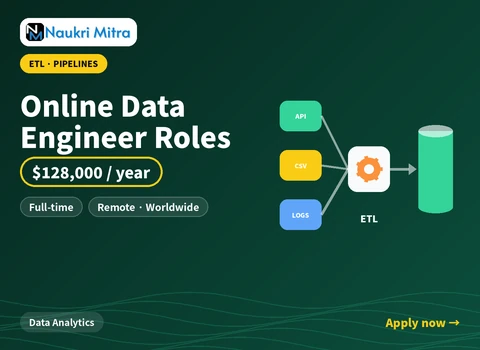
A data engineer role is open, fully remote, and pays $128,000 per year to candidates anywhere. It's a full-time position in data and analytics, and it sits upstream of most other data roles, building the pipelines and infrastructure that analysts and data scientists depend on without necessarily thinking about it.
Every dashboard and every model rests on data that had to get moved, cleaned, and organized by someone before any of that visible work could happen. This role does that groundwork, and doing it well means the rest of the data team rarely has to think about where their data actually comes from.
What the role owns
- Design and run the pipelines and warehouses everything else depends on
- Keep an eye on data quality so reliability doesn't quietly slip
- Hand data scientists and analysts something clean and ready to work with
Pipeline failures aren't always dramatic outages that trigger an obvious alert. A pipeline can run successfully every night according to its own monitoring, while a slow API call occasionally times out and silently drops a small percentage of records. Nobody notices until an analyst downstream tries to reconcile a number against a different source and the totals don't match, at which point tracing the discrepancy back to a quiet, partial data loss takes real investigative work. Building monitoring that catches gradual, incomplete failures, not just hard crashes, is central to keeping this role's output trustworthy.
Supporting analysts and data scientists means understanding how the data actually gets used downstream, not just moving it from one place to another. A table that's technically accessible but poorly documented, with column names that don't explain themselves and no clear record of what transformations were applied, creates real friction for anyone trying to build on top of it. Structuring data thoughtfully from the start saves everyone else on the team from having to reverse-engineer the same questions repeatedly.
Scaling a pipeline often surfaces problems that never showed up at smaller volumes. A transformation step that ran fine against a modest dataset can grind to a crawl once the underlying table grows past a certain size, and the fix usually isn't a small tweak but a genuine redesign of how the data moves through the pipeline. Anticipating that kind of growth before it becomes an emergency is part of building infrastructure that lasts.
What's required
A bachelor's degree in computer science, or something close to it, is the formal ask, and real hands-on pipeline experience tends to matter more in an interview than which specific program someone came through. Thirty months of genuine, hands-on time building and running production pipelines is the bar here. Candidates should already be comfortable writing SQL and Python day-to-day and working inside a cloud-based data platform, not picking those up on the job.
- SQL
- Python
- ETL pipelines
- Cloud data platforms
- Data warehousing
- Big data tools, including Spark
- Database design
Hands-on experience with an orchestration tool like Airflow for scheduling and managing pipeline dependencies carries real weight, since manually running scripts in sequence doesn't scale past a handful of simple jobs. Familiarity with a data quality testing framework, comfort working with streaming data through something like Kafka, and some background applying infrastructure-as-code practices to data infrastructure specifically will all strengthen an application.
Database design skills matter more here than many job listings acknowledge. A warehouse table modeled poorly at the start tends to accumulate workarounds over time as more use cases get bolted onto a structure that wasn't built to support them, and someone with a real eye for schema design saves the team from that slow accumulation of technical debt.
Pay and benefits
The role pays $128,000 annually. Remote-work flexibility comes alongside 401(k) matching, paid time off, and health insurance as part of the standard package. A number of employers hiring data engineers at this level also provide an employee assistance program supporting mental health and general wellbeing.
- Remote-work flexibility
- 401(k) matching
- Paid time off
- Health insurance
The work nobody sees until it breaks
Data engineering is foundational in a way that makes it easy to overlook when things are going well. Naukri Mitra sees this pattern come up often in how the role gets discussed relative to more visible data positions: an analyst's polished dashboard or a data scientist's model gets the attention, while the pipeline quietly feeding both of them only gets noticed the moment it breaks, at which point everything downstream stops working at once.
Two systems occasionally disagree about which one holds the authoritative version of the same piece of data, and reconciling that kind of conflict- deciding which source actually reflects reality and rebuilding a pipeline around that decision- can turn into a genuinely large undertaking. It's not glamorous work, but getting it right prevents many confusing, hard-to-trace discrepancies downstream.
Getting there and applying
Data engineer remote salary at this level reflects the specialized infrastructure and software engineering skill the role demands, distinct from the more business-facing analytics roles it supports. People asking how to become a remote data engineer typically build a foundation in general software engineering first, then specialize into the specific patterns and tools that data pipeline work depends on.
Applicants should be ready to describe a specific pipeline they built or a data quality issue they caught before it reached downstream users, including how they diagnosed the problem. That kind of concrete detail tells a hiring manager far more about practical readiness than a general list of tools, since keeping a pipeline reliable under real production conditions is a very different skill from getting one working in a tutorial. A candidate who can also explain how they scaled a pipeline to handle unexpected growth demonstrates the kind of forward-looking design this role rewards.