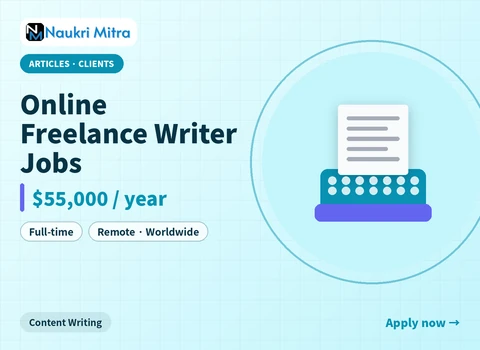
There's a remote, full-time Writer role open right now, paying $55,000 a year, and it's open to candidates anywhere.
What You'd Actually Be Doing
- Dig into a topic before writing a word of it, so the finished piece holds up under scrutiny
- Put together original pieces across a few different formats, think articles, site copy, and the occasional marketing piece
- Take editorial notes and turn them into a stronger second draft, not just a lightly touched-up copy of the first
The formats shift more than people expect going in. One assignment might be a straightforward explainer, and the next could be a piece meant to sell something, with a completely different rhythm and word choice required. Nobody hands you a single template and asks you to reuse it forever. A writer who's only ever worked in one register, always formal, always breezy, usually needs a bit of time to loosen up before this kind of range feels natural. Getting comfortable moving between those registers quickly tends to matter more here than mastering any single one of them perfectly.
A Sense of the Day-to-Day
Most work comes through a shared tracker rather than surprise emails, so there's usually a decent window to plan around an upcoming piece rather than scrambling the same afternoon it lands. Naukri Mitra runs the listing itself, though once an application moves forward, the hiring company takes over the interview process directly. How busy a given week gets depends a lot on client demand, so a stretch of heavier assignments is often followed by something lighter.
Briefs vary in how much detail they include. Some spell out the audience and tone clearly. Others leave more to figure out, and part of doing well here is being comfortable making a reasonable call on those gaps instead of stalling until someone spells it out for you. Deadlines tend to hold once they're set, though there's usually enough flexibility to flag a scheduling conflict early rather than pushing through it silently.
What You'll Need
A bachelor's degree is the floor for this one, typically in English, journalism, or something close. On the experience side, this role calls for 12 months of relevant writing work, and a portfolio spanning a few different formats will carry more weight than a single long stretch doing one kind of writing. Freelance experience counts just as much as staff experience here, provided the finished work speaks for itself.
- Strong writing and editing chops, meaning a draft that's actually close to done on the first pass
- Research skills good enough to sound credible on something you didn't know much about last week
- Real adaptability across tones, since one client's voice can be nothing like another's
- Comfort inside a content management system for publishing and formatting
- Grammar and mechanics that don't need a second set of eyes to catch the basics
- A feel for storytelling, particularly pacing that keeps someone reading past the first paragraph
Most candidates come in stronger on some of these than others, and that's expected. A writer with sharp research instincts might need a little coaching on pacing, and vice versa, so reviewers tend to weigh the actual writing samples heavily rather than any single line on a resume.
Extras Worth Having
None of this is required, but it'll help your application stand out. Some grasp of SEO basics goes a long way now, even for writing that isn't explicitly SEO-focused, since more clients expect at least a working knowledge of it. Having written across two or three unrelated industries already proves the adaptability this role is looking for better than a bullet point claiming it. Comfort with a formal style guide, AP, Chicago, or whatever a given client uses internally, tends to shave real time off the onboarding process too. Basic familiarity with a task tracker like Trello or Asana helps as well, since that's how most assignments here get handed off and tracked. A candidate who's already used to juggling several client voices at once, even informally, usually adjusts to this role faster than someone coming from a single in-house writing job.
Pay and Perks
This one pays $55,000 a year. Health insurance, paid time off, and full remote flexibility come with it, and some companies hiring for roles like this also throw in stock options or profit-sharing as part of the overall package. Exactly which extras apply tends to vary from one employer to the next, and those details usually get spelled out once an offer is actually on the table.
If You're New to This
People wondering how to become a remote writer without a long résumé usually do better focusing on a small, varied set of samples rather than trying to pad out their history. Three or four pieces that show real range in format and tone tend to get further in a first review than a stack of similar-sounding clips. Writer remote salary numbers across the industry back that up too, generally tracking a writer's range more closely than how many years they've technically been at it. Someone weighing this against writer jobs worldwide with a fixed office attached will usually find the pay gap between the two has narrowed considerably.
How to Apply
Send a resume along with two or three samples that show off some range. A cover letter isn't mandatory, but a quick line about which sample you'd point someone to first tends to help whoever's reviewing move faster. Applications get looked at as they come in, and people who move forward usually hear something back within about two weeks. If a sample was written under a real deadline rather than at a leisurely pace, mention that, since it gives reviewers a better sense of how you handle the pace this role runs at.