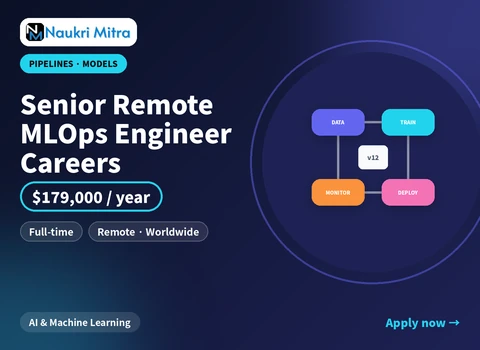
A senior MLOps engineer role is open, fully remote, paying $179,000 a year to candidates anywhere. It's a full-time position in AI and machine learning, focused on the pipelines and infrastructure that keep ML models training, deploying, and running reliably long after the initial build.
A model that performs well the day it ships is only half the story. Data shifts, dependencies get updated, and the systems around a model keep changing, which means someone has to own the ongoing machinery that retrains, redeploys, and watches over models well past launch day. That ownership is what this role provides.
What the role owns
- Build and maintain pipelines that train, deploy, and monitor ML models in production
- Automate model retraining so it doesn't rely on someone remembering to kick it off manually
- Keep the whole system reliable and able to scale as demand grows
Automated retraining sounds like a clear win until the automation itself becomes the problem. A retraining pipeline that fires on schedule without validating the incoming data can quietly retrain a model on a dataset that's partially corrupted or missing a whole segment, because an upstream data source failed silently rather than throwing an obvious error. Without a validation step to catch that before the new model is promoted, the pipeline ends up automating a mistake rather than a routine improvement. Building that kind of safeguard in is a core part of doing this job well.
Scalability work at this level goes beyond handling more traffic. It means designing pipelines that remain maintainable as the number of models grows from a handful to dozens, each with its own retraining schedule, monitoring thresholds, and rollback plan, without requiring a completely custom setup for each new model.
Monitoring in production means tracking more than whether a service is up. A model can remain perfectly available while its predictions quietly become less accurate, and catching that kind of silent degradation requires monitoring the actual output distribution over time, not just server health metrics that look fine right up until a customer complains about bad recommendations.
What's required
The formal ask is a bachelor's degree in computer science or engineering, though at this seniority a strong hands-on track record across both software engineering and ML workflows carries more weight than the degree line itself. Candidates need 66 months of experience spanning both disciplines, with proficiency in containerization and cloud infrastructure expected as a baseline, not something to pick up on the job.
- CI/CD pipelines
- Docker
- Kubernetes
- Cloud platforms
- Model monitoring
- Python
- Infrastructure as code
- MLflow or a comparable tool
Experience with an orchestration tool like Kubeflow or Airflow tends to stand out, since coordinating multi-step ML pipelines reliably is a different problem than orchestrating general software deployments. Familiarity with feature store architecture, hands-on experience managing a model registry across multiple production versions, and comfort with canary or shadow deployment strategies for rolling out new models safely will all strengthen an application at this level.
Cost awareness matters more at this level of seniority, too. Training pipelines that spin up GPU instances on a schedule, whether or not a retrain is actually warranted, can quietly waste a meaningful chunk of a team's infrastructure budget, and building in checks that skip unnecessary retraining runs is the kind of unglamorous optimization that senior engineers are expected to catch on their own.
Compensation
The role pays $179,000 annually. Retirement plan matching and remote-work flexibility come alongside paid time off and health coverage as part of the standard package. Professional development budgets for cloud and MLOps certifications are included as well, which matters given how quickly best practices in this space continue to shift.
- Retirement plan matching
- Remote-work flexibility
- Paid time off
- Health coverage
- Professional development budget for cloud and MLOps certifications
What senior MLOps actually means
MLOps sits in an unusual spot, blending the discipline of software engineering with the particular unpredictability of machine learning systems. Naukri Mitra sees candidates for senior roles like this one distinguish themselves less by which tools they've used and more by how they think about failure modes, specifically the ones unique to ML pipelines rather than general software deployments, like a model silently degrading without triggering any error at all.
A model registry with several versions tagged "production" and no clear record of which one is actually serving live traffic is a more common problem than it should be, and untangling that kind of ambiguity, then putting guardrails in place so it doesn't happen again, is exactly the kind of ownership this role expects at a senior level. Nobody wants to discover during an incident that they've been debugging the wrong model version for twenty minutes.
Getting to this level and applying
A remote MLOps engineer at this seniority reflects how rare it is to find someone genuinely strong in both software engineering rigor and the specific quirks of ML systems. Most people learning how to become a remote MLOps engineer come from a software engineering or DevOps background first, then absorb the ML-specific concerns over years of working alongside data scientists and ML engineers, rather than starting in machine learning and picking up infrastructure skills as an afterthought.
Candidates should be ready to describe a real incident involving an ML pipeline, not just a general infrastructure outage, including what the automation missed and what changed afterward to prevent a repeat. That kind of story reveals far more about readiness for a senior role than a list of tools ever could, since anyone can name Kubernetes and MLflow, but far fewer can explain exactly how a retraining pipeline quietly went wrong and how they caught it. Given the salary and the experience bar at this level, expect that story to come up directly in the interview process rather than staying buried in a resume bullet point.