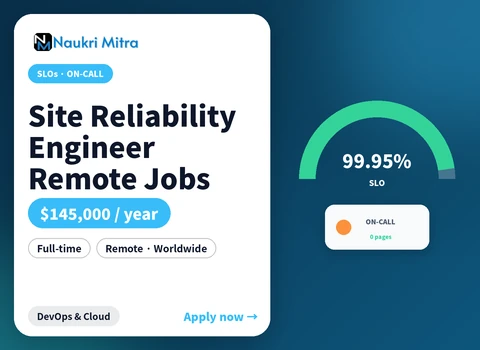
Site reliability engineer, fully remote, $145,000 a year, open to candidates anywhere. This one sits in DevOps and cloud infrastructure, and it's built around keeping critical services up rather than shipping new features.
The distinction between this role and a standard DevOps position comes down to focus. Where a DevOps engineer often splits time between deployment tooling and infrastructure builds, this role is measured specifically against uptime and reliability targets, and the day-to-day work follows from that.
What the role owns
- Monitor and maintain system uptime and performance
- Automate operational tasks
- Lead incident response to minimize downtime for critical services
Incident response is where this job earns its salary. A downstream payment service can start timing out under normal load, and if the upstream services calling it aren't built with sane retry limits, the resulting retry storm can amplify that one slow dependency into a full outage across a cluster that was otherwise healthy. Recognizing that pattern quickly, and knowing which service to throttle first, separates someone who can lead an incident from someone who's just watching dashboards during one.
Automation work here mostly exists to prevent that kind of scenario from happening. Toil, the repetitive manual work that eats into an SRE's week, is something this role is expected to actively reduce over time, not just tolerate as part of the job.
Capacity planning ties into this too, often further ahead of actual need than people expect. A service that handles current traffic comfortably can start buckling under a seasonal spike or a marketing campaign that drives a sudden surge, and part of the job is modeling that growth in advance rather than reacting once the graphs start climbing.
Requirements
A bachelor's degree is required, most often in computer science, given what this kind of role typically draws on. Candidates need three years of hands-on experience maintaining highly available production systems, along with strong scripting and automation skills that go well beyond writing the occasional one-off script.
- System reliability
- Monitoring and alerting
- Incident response
- Automation scripting
- Cloud platforms
- Capacity planning
Direct experience with SLOs, SLIs, and error budgets carries a lot of weight in reviews, since that framework is how many mature SRE teams decide when to slow down feature work in favor of reliability work. Familiarity with Prometheus and Grafana for monitoring, some exposure to chaos engineering practices, and comfort with a specific incident management platform like PagerDuty will all strengthen an application beyond the core requirements.
Load testing experience is worth mentioning specifically too. Knowing how to push a system to its actual breaking point in a controlled way, rather than discovering that limit for the first time during a real traffic surge, is a skill that comes up repeatedly in this line of work and doesn't always show up on a standard resume.
Pay and what comes with it
The salary is $145,000 annually, reflecting both the experience bar and the on-call responsibilities that come with the role. Health coverage, paid time off, and 401(k) matching are included as standard, and on-call compensation is included separately in the package, recognizing that being reachable outside business hours is real work, not an unpaid extension of the job. Many employers hiring SREs at this level also run performance reviews tied to merit-based pay increases.
- Health coverage
- Paid time off
- 401(k) matching
- On-call compensation
The on-call reality
Being on call means genuinely being available when something breaks, including outside normal working hours, and that's a defining part of this role, not a minor detail buried in the fine print. Naukri Mitra hears from a lot of SRE candidates who weigh this factor heavily when comparing offers, since the difference between a well-run on-call rotation and a poorly run one can shape someone's quality of life significantly.
A blameless postmortem culture, where the goal after an incident is to understand what happened rather than assign fault, tends to separate strong SRE teams from weaker ones. Writing a clear postmortem after a serious incident, one that other engineers can actually learn from, is as much a part of the job as fixing the immediate problem.
Rotations vary by team, but a typical setup shares on-call responsibility across several engineers so no one person carries the pager every week. Anyone evaluating this role should ask directly about rotation frequency and average incident volume during the interview process, since those details shape day-to-day life here more than almost anything else in the job description.
Career context
A remote site reliability engineer salary at this level reflects a role that most people don't step into directly out of school. The typical path runs through a few years in systems administration, DevOps, or backend development first, building the production experience that makes someone genuinely useful during a live incident rather than someone learning the systems for the first time while they're on fire. People researching how to become a remote site reliability engineer should expect that runway, not a shortcut, and three years is closer to a floor than a stretch goal for this particular opening.
What stands out in a strong application here is specificity about past incidents: what broke, how it was diagnosed, and what changed afterward to prevent a repeat. A candidate who can walk through one real incident in detail, including what went wrong in the initial response, tends to make a stronger impression than one who lists monitoring tools without describing how they were actually used under pressure. The three-year experience bar exists precisely to filter for that kind of lived incident history rather than theoretical knowledge of reliability practices.