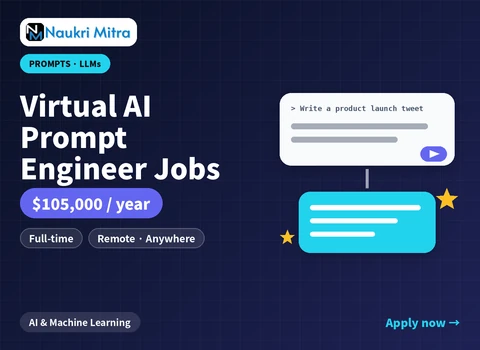
Virtual AI Prompt Engineer, full-time, fully remote, $105,000 a year, open to candidates anywhere.
Responsibilities
Design, test, and refine prompts to improve the accuracy and reliability of large language model outputs
Document effective prompting patterns so the work doesn't stay locked in one person's head
Collaborate with product and engineering teams to get prompts integrated into real applications
A support-response prompt on one project worked reliably for weeks, then quietly began giving inaccurate answers after the underlying model received a routine behind-the-scenes version update. Nobody noticed until a customer flagged it, because the evaluation set hadn't been re-run since the prompt originally shipped. The fix itself was straightforward. The bigger lesson was that a prompt isn't something you write once and leave alone, since the model it's talking to can shift under it without warning.
Refinement work makes up a big chunk of the job beyond initial design. A prompt that handles the common cases well often falls apart on edge cases: unusual phrasing, ambiguous requests, or inputs the original testing never anticipated. Finding and closing those gaps before users run into them is a large part of what separates a prompt that works in a demo from one that holds up in production.
Skills
Prompt design
Large language models
Python
API integration
Natural language processing basics
Evaluation frameworks
Dataset curation
Evaluation frameworks matter more here than most people expect going in. Writing a prompt that works well on a handful of test cases is easy. Building a repeatable way to measure whether it's still working after a model update, a prompt tweak, or a shift in how users are phrasing their questions is the harder and more valuable skill.
Dataset curation ties directly into that evaluation work. A test set built from ten hand-picked examples tells you very little. A test set built from real user queries, including the messy and ambiguous ones, tells you a lot more, and putting that kind of set together is treated as core work rather than a side task.
Experience and education
This role requires a bachelor's degree, generally in computer science, linguistics, or a related field. Alongside that, it calls for 12 months of demonstrated experience crafting and testing prompts for large language models specifically. Familiarity with LLM APIs and evaluation techniques is expected from day one, not something picked up gradually over the first few months.
One year is a shorter bar than a lot of roles in this space, and that's intentional. Prompt engineering as a discipline is young enough that few candidates have five years of dedicated experience, so the role is built around finding someone with solid, demonstrable hands-on work rather than a long tenure that simply doesn't exist yet in this field.
Pay and benefits
This role pays $105,000 a year. It comes with time off, remote-work flexibility, and health coverage, as well as a professional development stipend specifically for AI tools and training. That stipend has been useful for staying current with new model releases and evaluation techniques, since the underlying tools in this space change often enough that a one-time onboarding isn't enough.
Naukri Mitra is coordinating recruitment for this opening, and the professional development stipend is available from the first quarter of employment rather than after a waiting period.
Compared to AI prompt engineer remote salary figures at the one-year experience mark, this offer sits well above what's typical, reflecting the practical demand for people who can make prompts reliable in production rather than just clever in a demo.
How the work fits together
This role sits close to both the product and engineering sides of the company, closer than many AI prompt engineer jobs worldwide, which often stay siloed within a single AI team. A product manager might flag that users are getting inconsistent answers to a specific type of question, and determining whether that's a prompt problem, a model limitation, or something in how the request is formatted before it reaches the model is a normal part of the investigation.
Documentation matters more here than the title might suggest. A prompt that works well but exists only in one engineer's head is a liability the moment that person is out sick or moves to a different project. Writing down what works, what doesn't, and why, in a way someone else can pick up and extend, is treated as real output, not administrative overhead.
Model behavior shifts are a recurring theme in this line of work. Providers update their models, sometimes with advance notice and sometimes without, and a prompt that performed well last month can quietly start behaving differently after an update nobody flagged internally. Building evaluation habits that catch that early, rather than relying on a user complaint to surface it, is a core part of doing this job well.
None of this happens in isolation from cost. Longer, more elaborate prompts tend to produce better results up to a point, but they also cost more to run at scale, and part of the job involves striking a balance between output quality and the token cost of getting there, especially for features that see high volume.
Applying
Send a resume along with a short description of a prompt you built and iterated on, including how you measured whether it was actually working. Interviews include a hands-on prompt-design exercise and a brief conversation about evaluation methodology and working with product teams.