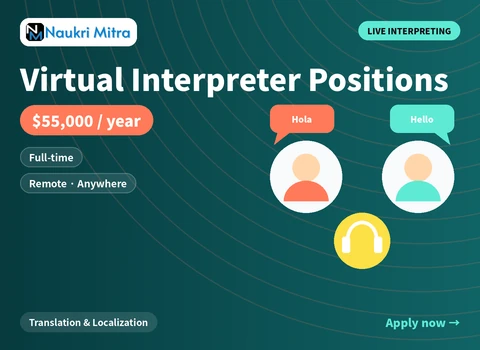
Two people who don't share a language need to understand each other right now, in the middle of a call or a meeting, with no time to look anything up. That's the moment this role exists for. It's a full-time, fully remote interpreting position open to candidates anywhere, paying $55,000 a year.
The day-to-day
- Carry spoken conversation between two parties as it happens, live on calls, video meetings, or scheduled appointments
- Keep the tone and intent of what's said intact, not just the literal words
- Read the room enough to flag when something needs cultural context rather than a direct swap between languages
A medical appointment interpretation and a business negotiation call ask for genuinely different instincts. The medical setting rewards precision above almost everything else, since a slightly off phrase about symptoms or dosage can cause real confusion. The negotiation call rewards something closer to diplomacy, catching when a blunt phrase in one language would land as rude in another and adjusting on the fly without changing what was actually said. Both situations happen in the same week, sometimes the same day, and the switch between them has to be immediate.
What's required to apply
A bachelor's degree is the baseline education requirement. Fluency in at least two languages is essential, obviously, and two years of professional interpreting experience rounds out the qualifications. Formal interpreter certification is required for certain assignment types, particularly medical or legal work, so having that credential already in hand opens up more of the available project mix from day one. Candidates without that specific certification yet can still qualify for the general assignment pool while working toward it.
Skills that get tested
- Genuine fluency in two or more languages, not classroom-level familiarity
- Comfort with both simultaneous interpreting, where you're speaking almost alongside the original speaker, and consecutive interpreting, where you wait for a pause and then relay what was said
- Cultural competency sharp enough to catch when a literal interpretation would miss the actual point being made
- Active listening that holds up over long calls without drifting
A working sense of when to interpret literally versus when to adapt phrasing for the situation matters just as much as vocabulary size, though it rarely gets its own line on a resume. It tends to show up more clearly in a live assessment than in any written credential.
Certification through a body like CCHI or NBCMI for medical work, or a court interpreter credential for legal settings, makes an application stronger and opens the door to higher-paying specialized assignments. Comfort with video remote interpreting platforms specifically, rather than just phone-based work, also matters more each year as more organizations move interpretation online. A candidate who's already comfortable troubleshooting a shaky video connection mid-call tends to handle the technical side without it becoming a distraction from the interpreting itself.
Pay and benefits
- Flexible remote scheduling
- Health insurance
- Paid time off
Flexible scheduling is close to universal across interpreting work, contract or salaried. Naukri Mitra notes that this particular role is salaried, which brings standard health and paid time off benefits into the package alongside that scheduling flexibility. A lot of contract interpreting work in the broader market doesn't include those benefits, so having them attached to a salaried role is worth weighing against the flexibility of contract assignments elsewhere.
The part that's genuinely demanding
Simultaneous interpreting, in particular, requires a lot of concentration for sustained stretches. Holding two languages active in your head at once, listening and speaking nearly simultaneously, is mentally exhausting in a way that's hard to appreciate until you've actually done it for an hour straight. Most interpreters build up stamina for that over their first year or two on the job. Short breaks between calls matter more here than in most remote roles, since the mental fatigue accumulates in a way that's easy to underestimate at first.
There's also real satisfaction on the other side of it. Watching two people genuinely connect, negotiate, or resolve something because the language barrier is no longer a barrier is a specific kind of reward that shows up regularly in this line of work, even on an otherwise routine day. It's the kind of moment most interpreters mention first when asked why they stayed in the field.
Who tends to do this work well?
People who grew up speaking two languages at home and then formalized that fluency through coursework or certification make up a large share of this field. Former translators looking to move into live, real-time work also transition in, though the shift from written to spoken interpretation takes real adjustment since there's no chance to revise a sentence once it's out. That adjustment period usually shows up most clearly in the first few weeks of live calls, before the reflex catches up to the training.
Remote interpreter jobs like this one suit people who stay calm under pressure, since a live call doesn't pause while you think through a tricky phrase. The ones who do well here tend to trust their first accurate read rather than freeze up while searching for a perfect word. A brief, slightly imperfect interpretation delivered instantly usually serves the conversation better than a delayed one polished for style.
Pay context
Interpreter remote salary figures at this experience level generally track close to $55,000, and people asking how to become a remote interpreter usually find that certification in a specialized field, medical or legal especially, is what moves pay upward faster than general language fluency alone. Building that specialty typically happens by taking on assignments in one area consistently until it becomes a recognizable strength on a resume.
Applying
Submit a resume along with your language pairs and any certifications you hold. Note whether you have experience with simultaneous work, consecutive work, or both, since assignments get matched based on that distinction. Applications are reviewed on a rolling basis, and candidates who advance typically undergo a live interpreting assessment before a final decision is made. That assessment usually involves a short mock call rather than a written test, since spoken performance is what the role actually depends on.