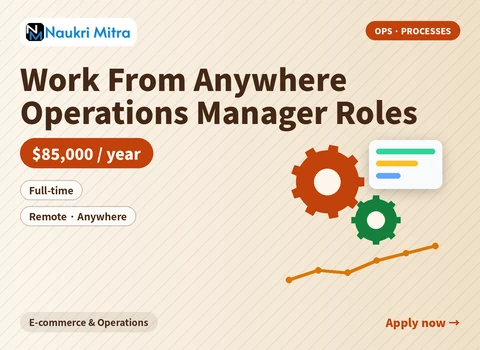
An operations manager is the person who notices when a process is quietly costing the business time or money, and actually does something about it before it becomes a bigger problem. This is a full-time, fully remote role open to candidates anywhere, paying $85,000 a year. The scope runs from daily operational oversight to budget ownership to direct team leadership, all under one title.
What the role covers
- Keep daily business operations running smoothly across teams and functions
- Identify where a process is inefficient and build a better one
- Own budget planning and staff management for the areas under your oversight
- Hold the team accountable to service standards and operational targets
A single week might involve reworking an onboarding process that's been quietly frustrating new hires for months, then pivoting into a budget review where a vendor cost has crept up without anyone noticing, then closing with a staffing conversation about whether a team is stretched too thin heading into a busy quarter. The breadth is real, and the role asks you to move between these without losing momentum on any of them. No single week looks quite like the last one.
Background required
A bachelor's degree is required, typically in business administration or operations management. Four years of experience improving processes and leading teams is what the role calls for. That track record matters more than the specific industry background, since the core skill, spotting inefficiency and fixing it, transfers across most operational settings. Someone who's led a small team through a genuine process redesign brings more relevant experience than someone who's only managed steady, unchanging operations for years.
Skills that get used constantly
- Process improvement, actually redesigning a workflow rather than just documenting what's broken about it
- Project management, keeping multiple initiatives moving without letting any of them stall
- Team leadership, since this role manages people directly, not just processes
- Budgeting, with real accountability for where money goes
- Data analysis, using numbers to justify a change rather than a gut feeling
- Cross-functional coordination, since almost nothing in operations happens inside a single department
A working sense of when to fix a process versus when to accept it's good enough for now matters just as much as the technical skill of process redesign itself. Chasing perfection on every workflow tends to slow a team down more than it helps.
Lean or Six Sigma training gives an application real credibility, and hands-on experience with project management platforms like Asana or monday.com speeds up onboarding considerably. Experience managing a fully remote or hybrid team specifically is also a genuine plus, since remote operations management carries its own set of coordination challenges that in-office experience doesn't fully prepare someone for. Knowing how to catch a struggling team member's warning signs without the benefit of in-person cues is a real, learnable skill this role depends on. It's usually one of the harder adjustments for someone moving from an in-office leadership role into a remote one.
Compensation
- Health coverage
- Paid time off
- 401(k) matching
- Performance bonuses tied to operational results
Naukri Mitra notes that this employer also provides a home-office equipment allowance for remote staff, a benefit some companies in this space skip entirely, along with a wellness stipend that rounds out the package beyond the standard offerings above. Specific amounts and eligibility for those extras typically come up during the offer conversation.
What makes the role demanding
Operations work rarely has a single clean problem to solve. A staffing shortage in one department often collides with a budget constraint in another, and untangling both at once, without letting either one slide, is a normal Tuesday rather than an exceptional crisis. The role asks for genuine comfort holding several competing priorities at once. Some weeks that balance holds easily. Others require real triage about which fire actually needs attention first, and getting that call wrong even once tends to teach a lasting lesson.
The payoff is concrete, though. Watching a process you redesigned actually cut turnaround time, or seeing a budget you managed come in under target without cutting corners, gives a kind of visible proof of impact that's harder to point to in many other management roles. Those numbers go directly into review conversations, with little translation needed.
Who tends to succeed here?
People who've managed a team through a genuine operational overhaul, not just steady-state management, tend to be strong fits, since this role asks for active improvement rather than maintenance. Backgrounds in logistics, retail operations, or service delivery all translate well, since the core discipline of managing people and process together carries over regardless of the specific industry. Someone who's led a team through a system migration or a major workflow change tends to have exactly the kind of pattern this role calls for repeatedly.
Remote operations manager jobs like this one suit people who communicate proactively rather than waiting to be asked for a status update. Leading a distributed team well means over-communicating slightly rather than assuming silence means everything is fine. A team spread across time zones can't rely on the hallway conversations that used to catch problems early.
Pay and career path
Operations manager remote salary figures at this experience level generally align with what this role offers, and people asking how to become a remote operations manager usually find that a documented history of measurable improvements, cost savings, faster turnaround, and higher retention matters more in review than years of experience alone. Specific numbers on a resume tend to carry more weight than a general description of responsibilities.
Applying
Send a resume along with a specific example of a process you improved and the measurable result it produced. Applications are reviewed on a rolling basis, and candidates who advance typically go through a case-style interview walking through how they'd approach a real operational problem. That exercise usually draws on a scenario close to what the team is actually dealing with, rather than a generic hypothetical, so specificity in your own examples tends to land well.