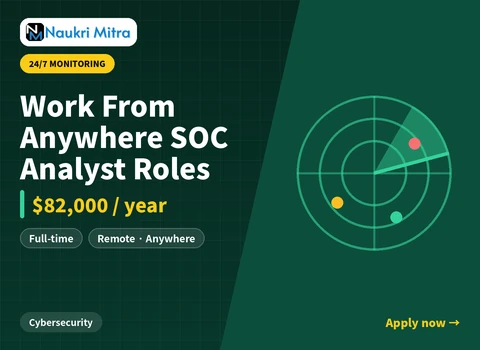
Work From Anywhere SOC Analyst
This full-time, remote SOC Analyst position pays up to $82,000 a year and can be worked from anywhere. It's built for someone who already has some hands-on monitoring experience and wants to move into a structured security operations team.
What the job actually involves
- Monitor security alerts and logs around the clock
- Triage and investigate potential threats as they surface
- Escalate confirmed incidents to senior analysts for response
That "around the clock" part matters more than it might seem at first glance. SOC coverage doesn't stop at 5 pm, so teams typically run rotating shifts, and analysts hired into this kind of role should expect some nights, weekends, or early mornings depending on how the schedule is staffed. It's not a nine-to-five job dressed up as one.
Alerts don't arrive labeled by severity, so a large part of the job is figuring that out yourself before anyone else gets involved. A spike in failed login attempts from an unfamiliar region might be a misconfigured script, or it might be the first sign of something worse, and telling the difference under time pressure is a skill that gets sharper with repetition. New analysts usually start with more supervision on that judgment call and gain independence over their first several months.
Requirements
A bachelor's degree is the minimum education level for this posting. Most candidates come to it with a background in cybersecurity, information technology, or a similarly technical field, though the degree itself matters less than what a candidate has actually done with alerts and logs day-to-day. The role calls for 18 months of hands-on experience monitoring security alerts, and a foundational security certification is generally expected alongside that experience rather than treated as optional.
SIEM familiarity comes up frequently when hiring for this type of role, and Naukri Mitra lists it as a near-universal expectation across SOC postings at this level. If you've spent time inside Splunk, QRadar, or a comparable platform, even briefly, that experience will carry real weight in an interview.
Skills you'll use
- SIEM tools
- Threat detection
- Log analysis
- Incident triage
- Network protocols
- Security+ certification
Beyond that list, a few things tend to make an application stand out. Analysts who've worked with the MITRE ATT&CK framework to classify threat behavior, who can write a basic PowerShell or Python script to speed up repetitive log review, or who hold a CompTIA CySA+ alongside Security+ usually move through screening faster. None of these are hard requirements, but they signal that a candidate has gone slightly past the basics.
Pay and benefits
Base pay for this role runs up to $82,000 a year in USD. Given that SOC analyst remote salary figures vary widely by shift and employer, this sits at a competitive point for an 18-month experience bar, particularly once shift differentials are factored in.
- Health coverage
- Paid time off
- Shift differentials for off-hours coverage
- Certification support
Some companies hiring for SOC roles also add stock options or profit-sharing to the total compensation package, though that tends to depend on the specific employer rather than being standard across the field.
Certification support usually covers exam vouchers and study materials, and for someone building toward the CySA+ or an intermediate SIEM-specific credential, that support can meaningfully shorten the timeline. It's worth asking during an interview exactly what's covered, since the scope of that benefit varies more between employers than most of the others on this list.
Day to day and where it leads
A shift usually opens with a review of whatever queued up overnight, then settles into a rhythm of watching dashboards, running down alerts that look off, and documenting what turns out to be nothing versus what needs to be kicked upstairs. Slow shifts exist, but so do busy ones, and the job asks analysts to stay sharp through both. Escalation is a real skill here too: knowing when something genuinely needs a senior analyst's attention, rather than either sitting on it too long or flagging every minor anomaly, is part of what separates a strong SOC analyst from someone still learning the ropes.
For people wondering how to become a remote SOC analyst on a longer timeline, this kind of position is usually the entry point rather than the destination. Analysts who spend a couple of years here, build out their certifications, and get comfortable with the escalation judgment mentioned above tend to move into threat hunting, incident response, or senior analyst tracks afterward.
Team size and structure vary by employer, but most SOC teams pair newer analysts with a more senior tier for backup on anything ambiguous, so nobody is expected to make a high-stakes call entirely alone in their first weeks. Tooling access, playbooks for common alert types, and a documented escalation path are usually in place before day one, which reduces the guesswork that can otherwise make early shifts stressful.
How to apply
Send your resume through the listing along with any certifications you currently hold or are working toward. Since this role is open to candidates worldwide with no fixed location, expect the hiring team to ask about your available shift windows early in the process rather than late, as schedule fit is one of the first things they'll need to confirm before moving forward.
Interviews for SOC roles at this level generally include a walkthrough of a sample alert or log excerpt, where you'll be asked to talk through how you'd assess it and what you'd do next. There's no single right answer expected, but the hiring team will be listening for a clear process: what you'd check first, what would prompt you to escalate, and what would prompt you to close it out as a false positive. Coming prepared with one or two real examples from your own monitoring experience, even something minor, tends to make that conversation go better than trying to answer purely in the abstract.