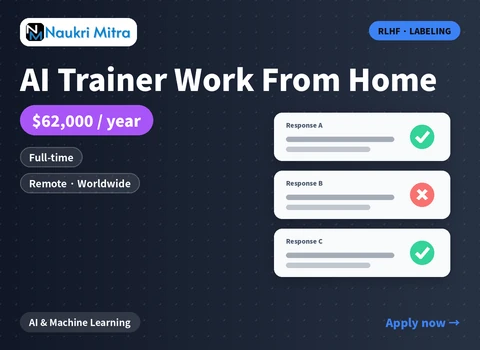
A work-from-home AI trainer role is open, full-time, and pays $62,000 per year to candidates anywhere. It sits within AI and machine learning, and the work is less about writing code and more about the kind of careful human judgment that teaches a model what a good response actually looks like.
Models don't improve on their own just by processing more data. Someone has to look at real outputs, decide which are actually good, and explain why in a way that's sufficiently consistent to shape the model's future behavior. That review work is what this role does, and it matters more to the final product than the job title might suggest.
What the work involves
- Evaluate and label model outputs for accuracy and quality
- Write and rank sample responses
- Give structured feedback that feeds into how the model gets improved
Ranking two responses that are both technically correct is harder than it sounds. One might answer the question fully but bury the useful part in unnecessary padding, while the other gets straight to the point but skips a caveat that actually matters. Learning to rank that kind of difference consistently, the way a careful reviewer would every time rather than based on mood or fatigue late in a long session, is the core skill this role is really testing for.
Labeling guidelines never cover every case. An output can land in a genuine gray area that the written instructions didn't anticipate, technically following the letter of a rule while missing its obvious intent, and knowing when to escalate that kind of edge case rather than guessing and moving on is part of doing the work carefully rather than just quickly.
Writing sample responses asks for a different skill than evaluating them. A trainer might need to draft what a genuinely excellent answer to a tricky question looks like, not just an acceptable one, and that means understanding the difference between a response that technically answers the question and one that actually serves the person asking it well.
What's needed
This one is listed at the bachelor's degree level, and candidates come from a genuinely wide range of fields. Linguistics and computer science both show up often, but so does deep expertise in some other specific subject, since strong writing and analytical ability can substitute for a formal AI background. Candidates need 6 months of relevant experience, and prior data labeling or content moderation experience is a plus but not required.
- Data annotation
- Content review
- Attention to detail
- Written communication
- Basic understanding of machine learning concepts
- Quality assurance
Subject-matter depth in a specific area, such as STEM fields, law, medicine, or software development, tends to make a candidate more competitive for specialized training projects that require real expertise behind the judgment calls, not just general reading comprehension. Familiarity with a specific annotation platform, some exposure to preference-ranking methods used in reinforcement learning from human feedback, and comfort with following a detailed style guide precisely will all help.
Multilingual ability is worth mentioning too, even though it's not always advertised as a core requirement. Companies training models to work well across languages need reviewers who can evaluate output quality in something other than English, and that skill set is often in shorter supply than general English-language review capacity.
Pay and benefits
The role pays $62,000 annually. Flexible scheduling, along with paid time off and health insurance, is part of the standard package for this full-time position. Because much AI trainer work is structured around completing a volume of review tasks rather than sitting through fixed hours, the flexibility in scheduling tends to matter more here than in a typical desk job.
- Flexible scheduling
- Paid time off
- Health insurance
What this kind of work actually looks like day to day
AI trainer roles have grown quickly as companies realized that improving a model well takes structured human judgment, not just more raw training data. Naukri Mitra sees a lot of candidates for roles like this one underestimate how repetitive the work can feel in long stretches, evaluating response after response against the same criteria, and overestimate how much creative writing is actually involved day to day.
Consistency across a full shift matters more than people expect walking in. A reviewer who applies slightly stricter standards in the morning than in the afternoon introduces noise into the training data that's genuinely hard to correct for later, and staying calibrated hour after hour is a real, learnable discipline rather than something that just happens naturally.
Quality checks on a trainer's own work are a normal part of the process too, not a sign of distrust. A second reviewer catching a subtle factual error buried in an otherwise well-written sample response is exactly how the overall system stays accurate, and being open to that kind of feedback loop, rather than treating every correction personally, tends to separate trainers who improve quickly from those who plateau.
Getting hired for a role like this
People asking how to become a remote AI trainer often come from teaching, editing, technical writing, or a specialized field where precise judgment about correctness and quality is already part of the job. Six months of relevant experience, the bar here, is achievable for someone coming from any of those backgrounds without needing prior AI-specific work history.
Applicants should expect a sample task as part of the process, usually labeling or ranking a handful of real outputs against guidelines provided upfront. How closely and thoughtfully that sample task gets done tends to matter more to a hiring manager than anything on a resume, since it's the clearest signal of the actual skill this role depends on.