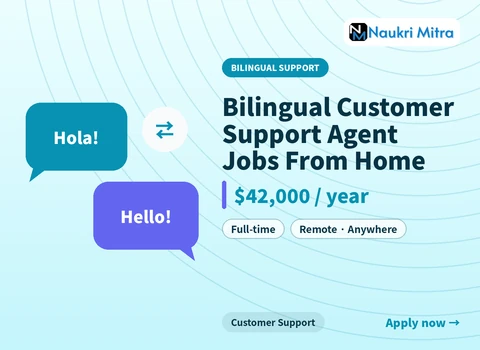
Bilingual customer support agents on this team handle the same range of customer issues as any support role, just across more than one language and often more than one channel in the same shift. This is a full-time, remote position open to candidates anywhere, with pay up to $42,000 per year.
A shift here might start with an email reply in English, move to a phone call in Spanish twenty minutes later, and close out with a French-language chat about a return. Switching between languages mid-shift takes a bit of mental adjustment at first, but agents who've done multilingual work before usually say it becomes automatic within the first month or so. The written channels demand a slightly different kind of precision than the spoken ones, since a typo in a second language reads very differently to a customer than a small stumble on a phone call does.
What the role covers day to day
- Assist customers in whichever language fits the interaction, across phone, chat, and email
- Resolve customer inquiries and complaints directly, escalating only when a fix requires access or authority the agent doesn't have
- Document every interaction in the company's support system, in enough detail that a colleague picking up the case later has full context
Candidates need fluency in English plus at least one additional language, along with a high school diploma or its equivalent. On top of the language requirement, about a year of prior customer service experience rounds out the qualifications, ideally in a role that already involved resolving customer problems rather than just following a script. That experience doesn't need to have been specifically bilingual work. Someone who spent a year in general customer service and is fluent in a second language from home life or schooling brings the same problem-solving foundation this role requires.
Skills the role leans on
- Genuine fluency in two or more languages, not just conversational familiarity, since written support especially requires precise wording
- General customer service ability, applied consistently regardless of which language a conversation happens in
- Comfort in help desk software for tracking and resolving cases
- Active listening, since tone and intent can get lost easily when someone's working in their second language on either end of the call
- Problem-solving for issues that don't come with an obvious first step
- Working knowledge of CRM tools for keeping customer history organized across channels
A third language beyond the required two is a genuine advantage here, particularly Portuguese, Mandarin, or Arabic depending on which regions a given employer serves. Naukri Mitra has seen candidates with three working languages get placed faster than equally qualified bilingual candidates, simply because it widens the pool of shifts they can cover. That's not a requirement to worry about going in, since most agents in this role work with exactly two languages and stay busy throughout their schedule.
Weekly scheduling usually accounts for which languages are needed most during a given stretch, so an agent's shifts might shift slightly week to week based on customer demand rather than staying fixed on the same hours indefinitely. New agents typically train for two to three weeks before taking on a full independent queue, with extra time built in to review written response templates in each language they'll support.
Pay for this role goes up to $42,000 annually in USD. Medical coverage and paid time off come with the full-time schedule, and shift differentials add extra pay specifically for the language skills an agent brings to a given shift. Part-time options are also available for anyone who doesn't want a full-time schedule.
- Health insurance
- Paid time off
- Shift differentials for language skills
- Part-time scheduling options
Language coverage needs shift depending on the day and the customer base an employer serves, so an agent might get scheduled more heavily into one language during a particular stretch based purely on demand. That's a normal part of the role rather than a sign that one language matters more than another. Agents typically stay proficient in both directions of a language pair by using it regularly, so gaps of several weeks without a particular language coming up are uncommon in practice. Occasionally, a slower stretch in one language does occur, usually tied to a seasonal dip in a specific customer region, and agents generally pick up more shifts in their other language during those windows rather than sitting idle.
For anyone wondering how to become a remote bilingual customer support agent without formal interpretation training, this role doesn't require such a credential. Growing up bilingual, studying a language extensively, or spending significant time living abroad all count toward the fluency requirement just as much as a language degree would. What matters in the end is whether an agent can hold a technical or emotionally charged conversation smoothly in that second language, not how the fluency was acquired.
Since the role is remote and open to candidates anywhere, it qualifies as a genuine work-from-home bilingual customer support agent position rather than one that requires periodic office visits. A dependable internet connection and a low-noise room to take calls in are what's actually needed to get started. A second monitor helps for keeping a translation reference or the support system open alongside an active conversation, though it isn't a strict requirement.
Interviews for this opening typically include a short language assessment covering both written and spoken skills in each language a candidate lists, since written accuracy doesn't always match speaking ability, and employers want both confirmed before an offer goes out. Candidates should come prepared to demonstrate both sides of that fluency rather than just discuss it. There's also room to grow from here. Agents who consistently perform well across languages sometimes move into a quality review role checking translated support content, or into a training position helping newer bilingual hires get comfortable switching between channels and languages in the same shift.