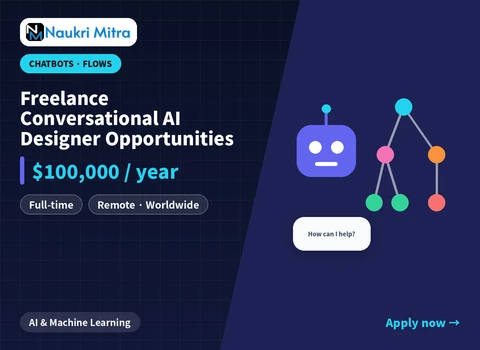
A conversational AI designer role is open, fully remote, and pays $100,000 per year to candidates anywhere. It sits within AI and machine learning, though the daily work leans heavily toward writing and user experience: shaping how a chatbot or voice assistant actually talks to people.
A well-designed conversation feels almost invisible when it works, guiding someone to what they need without them noticing the structure underneath. Getting there takes deliberate craft, not just plugging text into a chatbot builder and hoping the model fills in the gaps sensibly.
What the work involves
- Script and structure dialogue flows for chatbots and voice assistants
- Test conversations for clarity and tone
- Work with engineers to sharpen natural language understanding and the overall experience
A dialogue flow that reads smoothly in a script review can fall apart the moment a real user goes off-script. Someone says "never mind" halfway through a booking flow, or changes their mind about what they're asking for mid-conversation, and a bot without a graceful way to handle that just keeps looping back to the same clarifying question, growing more frustrating with every repetition. Designing for those detours, not just the clean, happy path, is where much of the real craft of this job lives.
Testing conversations for tone means listening for more than grammatical correctness. A response can be technically accurate and still feel cold, overly formal, or subtly condescending depending on word choice and pacing, and catching that gap between "correct" and "actually pleasant to talk to" takes deliberate testing with real conversation transcripts, not just a read-through of the script on paper.
Voice interfaces add a layer that text-based chat doesn't have to deal with. Pacing, pauses, and how a sentence sounds read aloud all shape whether a voice assistant feels natural or stilted, and a script that reads perfectly on a page can sound robotic or rushed once it's actually spoken, which means testing has to include listening, not just reading.
What's needed
A bachelor's degree is what's listed here. Linguistics, human-computer interaction, and communications programs all feed into this kind of work fairly naturally, given how much of the job is really applied language design. Candidates need 18 months of experience designing chatbot or voice assistant interactions, and familiarity with conversational AI platforms is commonly expected going in.
- Conversation design
- Natural language understanding
- UX writing
- Chatbot platforms
- Prototyping tools
- User testing
- Dialogue flow mapping
Hands-on experience with a specific platform like Dialogflow, Voiceflow, or Rasa carries real weight, since each handles intent recognition and flow logic a little differently. Experience designing fallback and error-handling conversations, some background developing a consistent voice and tone guideline for a brand, and familiarity with accessibility considerations specific to voice interfaces will all strengthen an application.
Managing context across a longer, multi-turn conversation is a skill worth calling out specifically, since a lot of conversation design falls apart the moment a user references something they said several exchanges earlier. Keeping track of that context, and designing for what happens when the system misremembers or loses it, separates a genuinely usable assistant from one that only works for short, single-purpose exchanges.
Pay and benefits
This position pays $100,000 annually. Remote-work flexibility comes alongside paid time off and health coverage as part of the standard package. Professional development budgets for UX and AI training are included as well, which matters given how much conversational design overlaps with both fields as they each continue to evolve.
- Remote-work flexibility
- Paid time off
- Health coverage
- Professional development budget for UX and AI training
Design work that happens to involve AI
Conversational AI design sits closer to UX writing and interaction design than to traditional machine learning work, even though it lives inside an AI and machine learning team. Naukri Mitra sees this as surprising for some candidates from a pure engineering background, who expect more coding and less careful attention to word choice, pacing, and how a single sentence lands emotionally with someone typing into a chat window at the end of a frustrating day.
Working with engineers on natural language understanding means the design and the technical model have to move together. A dialogue flow that assumes a user will phrase a request one specific way will fail constantly if the underlying model wasn't trained to recognize the many other ways people actually phrase the same request, and closing that gap takes real back-and-forth between what's designed and what the model can reliably detect.
Iteration based on real usage data matters more than getting a flow perfect before launch. A conversation that looks solid in internal review can reveal unexpected drop-off points once real users start interacting with it, and treating the first launch as a starting point to refine rather than a finished product tends to produce a noticeably better experience within the first few weeks.
Getting there and applying
Conversational AI designer remote salary reflects a role that blends two distinct skill sets people don't always develop together. People asking how to become a remote conversational AI designer often start in UX writing, content design, or linguistics, then pick up the technical side of conversational platforms through hands-on project work rather than treating it as a separate specialty learned first.
Applicants should bring a sample dialogue flow they've designed, ideally one that shows how it handles a user going off-script, not just the ideal path through a conversation. Walking through why specific wording choices were made and what changed after real user testing tends to say far more about design judgment than a general description of the conversational design experience. A flow that only shows the happy path tells a reviewer very little about how someone actually thinks through the messier, more realistic parts of the job.