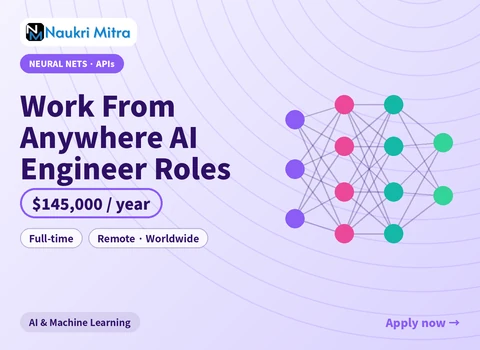
There's a fully remote AI engineer role open, paying $145,000 a year to candidates anywhere in the world. It's a full-time position in AI and machine learning, focused on getting AI features into real products, not just training models in isolation.
A lot of companies now want AI capability built directly into their products, not sitting off to the side as a research initiative. This role sits right at that point: taking a working model and making it a dependable part of something users actually interact with every day.
What you'd be doing
- Build, train, and ship machine learning models into live systems
- Optimize model performance
- Integrate AI features into applications
Integration work often involves anticipating what happens when a model doesn't respond as an application expects. A recommendation feature that calls out to a model service needs a sensible fallback when that call times out or returns empty, because showing a blank section of the app to a user is a worse experience than falling back to something generic. Building that kind of resilience into an AI feature, not just the happy path where everything works, is a real part of the job.
This role collaborates with both data scientists and software engineers, bridging two distinct sets of concerns. A data scientist cares about model accuracy and evaluation metrics; a software engineer cares about API contracts, error handling, and how a feature behaves under real traffic. Moving a model from an experiment into something the rest of the application can actually depend on means satisfying both.
Model performance optimization shows up constantly once a feature is live and traffic starts arriving in patterns nobody anticipated during testing. A model that responds instantly to a single request in a demo can slow down noticeably once dozens of requests hit it at the same time, and figuring out whether that calls for batching requests, caching common results, or simply provisioning more compute takes real hands-on troubleshooting.
What's expected
Education requirements call for a bachelor's degree, and computer science or data science is most common among applicants, though other closely related technical fields are accepted as well. Candidates need two years of hands-on experience building and deploying machine learning models, with strong Python skills and familiarity with a deep learning framework expected as standard.
- Python
- TensorFlow or PyTorch
- Machine learning pipelines
- MLOps
- REST APIs
- Cloud platforms: AWS, GCP, or Azure
- Model deployment
- SQL
Hands-on experience with large language models, particularly around prompt engineering or retrieval-augmented generation using a vector database, has become increasingly relevant and will stand out on a resume. Familiarity with a managed ML platform such as SageMaker or Vertex AI, and experience running A/B tests to evaluate a model feature's real-world impact rather than just offline metrics, will also strengthen an application.
Model optimization techniques for reducing inference costs, such as quantization or distillation, are worth mentioning as well, since running a full-sized model for every request often isn't economical once a feature reaches real scale. Someone who's actually shrunk a model for production use, rather than only ever deploying full-size research versions, brings a practical skill that's easy to undervalue on paper.
Pay and benefits
This position pays $145,000 annually. Retirement plan matching and remote-work flexibility come alongside paid time off and employer-sponsored health insurance as part of the standard package. Budgets for conferences, courses, or GPU compute resources are also included, which matters in a field where experimentation often requires real compute power beyond what a laptop can handle.
- Retirement plan matching
- Remote-work flexibility
- Paid time off
- Employer-sponsored health insurance
- Budget for conferences, courses, or GPU compute
Building AI into a real product
AI engineering, as a distinct role, has grown quickly and fills a real gap between pure research and pure software engineering. Naukri Mitra sees many candidates for this kind of role coming from backgrounds that lean heavily toward one side or the other, and the strongest applicants tend to be those who've deliberately built skills in both.
Shipping an AI feature also means thinking about cost in ways a research project rarely has to. Running inference on every user request adds up quickly at scale, and part of this role involves making real trade-offs among model size, latency, and the compute bill, rather than always reaching for the largest, most capable model available.
Generative AI features add a layer of unpredictability that traditional ML models largely lack. A well-trained classifier gives a consistent answer for the same input every time, but a language model can respond differently to nearly identical prompts, and designing an application around that variability, catching outputs that fall outside acceptable bounds before a user ever sees them, is a newer kind of engineering discipline that this role increasingly touches.
Getting there and applying
AI engineer remote salary at this level reflects how quickly demand has grown relative to the supply of people who can genuinely take a model from a research notebook into a shipped feature. People asking how to become a remote AI engineer often start in either a data science or software engineering role, then build the other half of the skill set through hands-on project work rather than coursework alone.
Applicants should be ready to describe a specific AI feature they helped ship, including how it degrades when something goes wrong and what happens to the user experience in that case. That kind of detail says more about production readiness than a description of model architecture alone, since anyone can train a model that works under ideal conditions. Fewer candidates can speak clearly to what happens when the model service is slow, the input is malformed, or the output falls outside what the application can safely display.